
Two-dimensional Function from Alemazkoor and Meidani (2018)#
import numpy as np
import matplotlib.pyplot as plt
import uqtestfuns as uqtf
The test function from [AM18] (or Alemazkoor2D for short)
is a two-dimensional polynomial function.
It was used as a test function for
a metamodeling exercise (i.e., sparse polynomial chaos expansion).
The function features a low-dimensional polynomial function (two-dimensional)
with a high degree (a total degree of \(20\)); in other words, the function
is low in dimension but of high-degree.
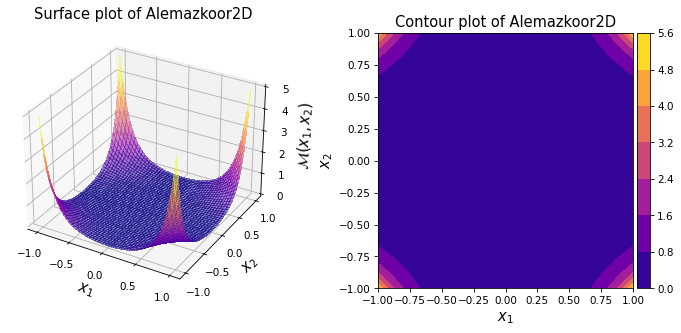
The surface and contour plots of the Alemazkoor2D function are shown below.
Test function instance#
To create a default instance of the Alemazkoor2D function:
my_testfun = uqtf.Alemazkoor2D()
Check if it has been correctly instantiated:
print(my_testfun)
Function ID      : Alemazkoor2D
Input Dimension  : 2 (fixed)
Output Dimension : 1
Parameterized    : False
Description      : Low-dimensional high-degree polynomial from Alemazkoor & Meidani (2018)
Applications     : metamodeling
Description#
The Alemazkoor2D function is defined as follows:
where \(\boldsymbol{x} = \{ x_1, x_2 \}\) is the two-dimensional vector of input variables further defined below.
Probabilistic input#
Based on [AM18], the probabilistic input model for the function consists of two independent random variables as shown below.
Show code cell source
print(my_testfun.prob_input)
Function ID     : Alemazkoor2D
Input ID        : Alemazkoor2018
Input Dimension : 2
Description     : Input specification for the 2D test function from
                  Alemazkoor & Meidani (2018)
Marginals       :

 No.    Name    Distribution    Parameters    Description
-----  ------  --------------  ------------  -------------
  1      X1       uniform       [-1.  1.]          -
  2      X2       uniform       [-1.  1.]          -

Copulas         : Independence
Reference results#
This section provides several reference results of typical UQ analyses involving the test function.
Sample histogram#
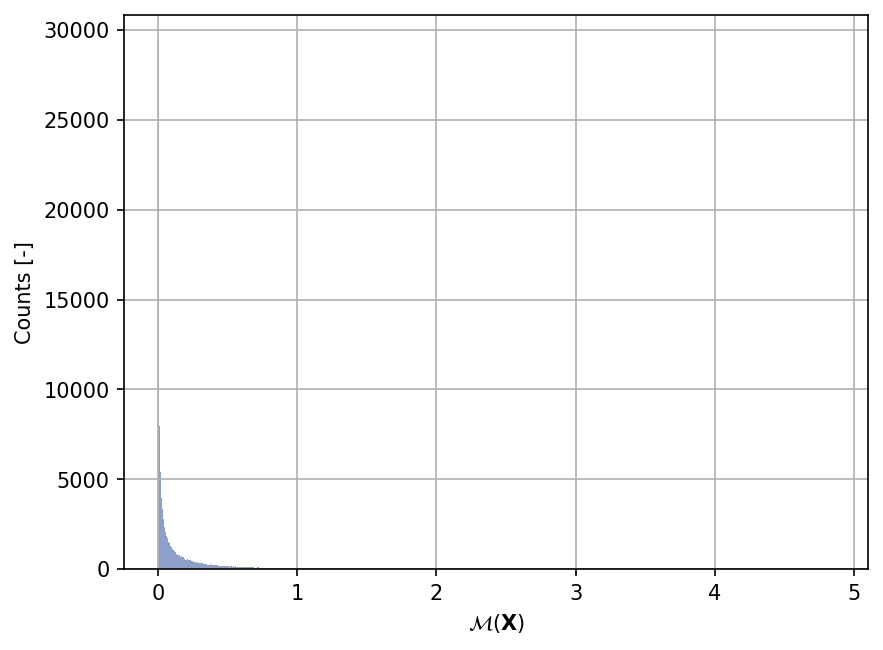
Shown below is the histogram of the output based on \(100'000\) random points:
Show code cell source
xx_test = my_testfun.prob_input.get_sample(100000)
yy_test = my_testfun(xx_test)

plt.hist(yy_test, bins="auto", color="#8da0cb");
plt.grid();
plt.ylabel("Counts [-]");
plt.xlabel("$\mathcal{M}(\mathbf{X})$");
plt.gcf().set_dpi(150);
References#
Negin Alemazkoor and Hadi Meidani. A near-optimal sampling strategy for sparse recovery of polynomial chaos expansions. Journal of Computational Physics, 371:137–151, 2018. doi:10.1016/j.jcp.2018.05.025.