
Flood Model#
import numpy as np
import matplotlib.pyplot as plt
import uqtestfuns as uqtf
The flood model is an eight-dimensional scalar valued function. The model was used in the context of sensitivity analysis in [IL15, LIPG13] and has become a canonical example of the OpenTURNS package [BDIP17].
Test function instance#
To create a default instance of the flood model:
my_testfun = uqtf.Flood()
Check if it has been correctly instantiated:
print(my_testfun)
Function ID      : Flood
Input Dimension  : 8 (fixed)
Output Dimension : 1
Parameterized    : False
Description      : Flood model from Iooss and Lemaître (2015)
Applications     : metamodeling, sensitivity
Description#
The flood model computes the maximum annual underflow of a river using the following analytical formula:
where \(\boldsymbol{x} = \{ q, k_s, z_v, z_m, h_d, c_b, l, b \}\) is the eight-dimensional vector of input variables further defined below. The output is given in \([\mathrm{m}]\). A negative value indicates that an overflow (flooding) occurs.
Note
Compared to the original function, this implementation inverted the sign of the output such that underflowing has a positive sign.
The model is based on a simplification of the one-dimensional hydro-dynamical equations of St. Venant under the assumption of uniform and constant flow rate and a large rectangular section.
Probabilistic input#
Based on [IL15] (Table 4), the probabilistic input model for the flood model consists of eight independent random variables with marginals shown in the table below.
Show code cell source
print(my_testfun.prob_input)
Function ID     : Flood
Input ID        : Iooss2015
Input Dimension : 8
Description     : Probabilistic input model for the Flood model from Iooss
                  and Lemaître (2015)
Marginals       :

 No.    Name    Distribution          Parameters                     Description
-----  ------  --------------  -------------------------  ---------------------------------
  1      Q      trunc-gumbel   [1013.  558.  500. 3000.]  Maximum annual flow rate [m^3/s]
  2      Ks     trunc-normal       [30.  8. 15. inf]      Strickler coefficient [m^(1/3)/s]
  3      Zv      triangular          [49. 51. 50.]           River downstream level [m]
  4      Zm      triangular          [54. 56. 55.]            River upstream level [m]
  5      Hd       uniform               [7. 9.]                    Dyke height [m]
  6      Cb      triangular        [55.  56.  55.5]                Bank level [m]
  7      L       triangular       [4990. 5010. 5000.]      Length of the river stretch [m]
  8      B       triangular        [295. 305. 300.]                River width [m]

Copulas         : Independence
Reference results#
This section provides several reference results of typical UQ analyses involving the test function.
Sample histogram#
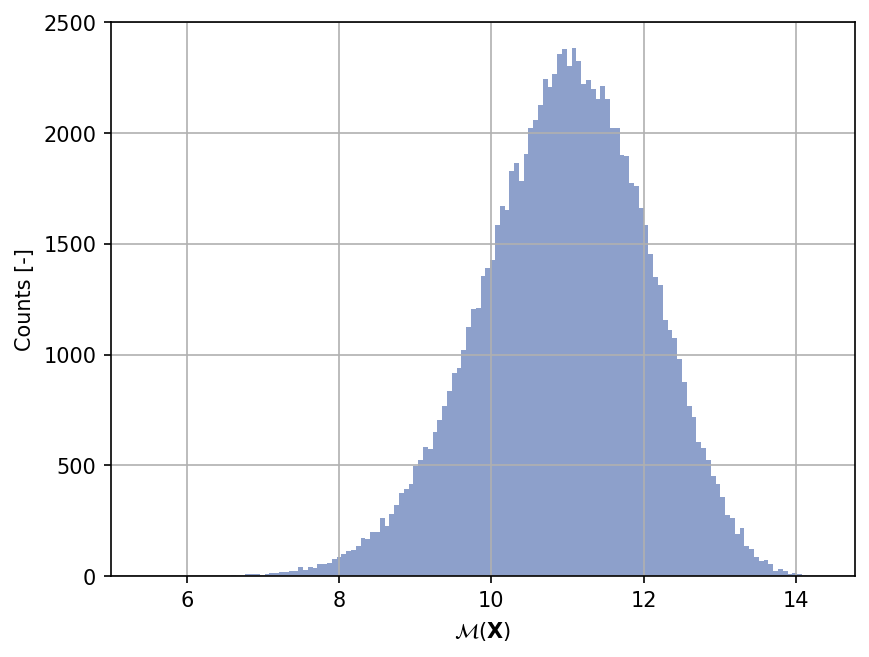
Shown below is the histogram of the output based on \(100'000\) random points:
Show code cell source
np.random.seed(42)
xx_test = my_testfun.prob_input.get_sample(100000)
yy_test = my_testfun(xx_test)

plt.hist(yy_test, bins="auto", color="#8da0cb");
plt.grid();
plt.ylabel("Counts [-]");
plt.xlabel("$\mathcal{M}(\mathbf{X})$");
plt.gcf().set_dpi(150);
Moments estimation#
Shown below is the convergence of a direct Monte-Carlo estimation of the output mean and variance with increasing sample sizes.
Show code cell source
# --- Compute the mean and variance estimate
np.random.seed(42)
sample_sizes = np.array([1e1, 1e2, 1e3, 1e4, 1e5, 1e6, 1e7], dtype=int)
mean_estimates = np.empty(len(sample_sizes))
var_estimates = np.empty(len(sample_sizes))

for i, sample_size in enumerate(sample_sizes):
    xx_test = my_testfun.prob_input.get_sample(sample_size)
    yy_test = my_testfun(xx_test)
    mean_estimates[i] = np.mean(yy_test)
    var_estimates[i] = np.var(yy_test)

# --- Compute the error associated with the estimates
mean_estimates_errors = np.sqrt(var_estimates) / np.sqrt(np.array(sample_sizes))
var_estimates_errors = var_estimates * np.sqrt(2 / (np.array(sample_sizes) - 1))

# --- Do the plot
fig, ax_1 = plt.subplots(figsize=(6,4))

ax_1.errorbar(
    sample_sizes,
    mean_estimates,
    yerr=mean_estimates_errors,
    marker="o",
    color="#66c2a5",
    label="Mean",
)
ax_1.set_xlabel("Sample size")
ax_1.set_ylabel("Output mean estimate")
ax_1.set_xscale("log");
ax_2 = ax_1.twinx()
ax_2.errorbar(
    sample_sizes + 1,
    var_estimates,
    yerr=var_estimates_errors,
    marker="o",
    color="#fc8d62",
    label="Variance",
)
ax_2.set_ylabel("Output variance estimate")

# Add the two plots together to have a common legend
ln_1, labels_1 = ax_1.get_legend_handles_labels()
ln_2, labels_2 = ax_2.get_legend_handles_labels()
ax_2.legend(ln_1 + ln_2, labels_1 + labels_2, loc=0)

plt.grid()
fig.set_dpi(150)
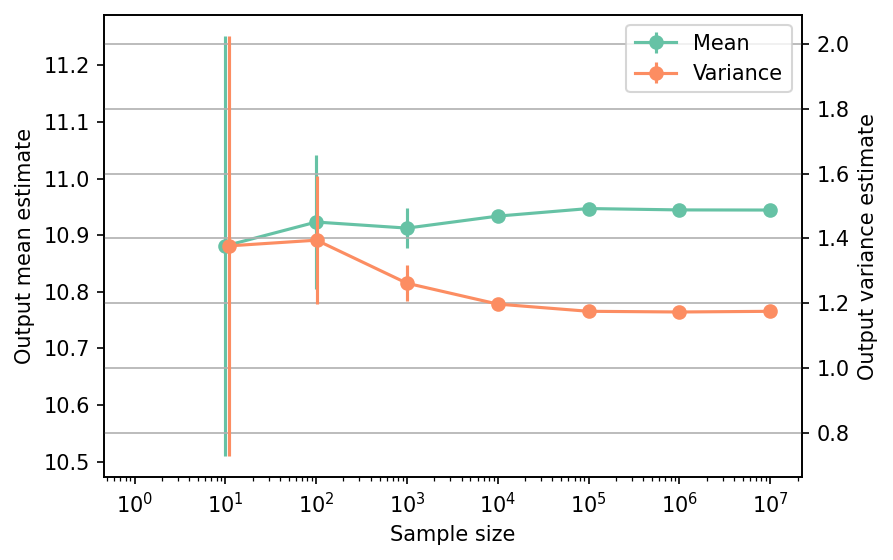
The tabulated results for each sample size is shown below.
Show code cell source
from tabulate import tabulate

# --- Compile data row-wise
outputs = []
for (
    sample_size,
    mean_estimate,
    mean_estimate_error,
    var_estimate,
    var_estimate_error,
) in zip(
    sample_sizes,
    mean_estimates,
    mean_estimates_errors,
    var_estimates,
    var_estimates_errors,
):
    outputs += [
        [
            sample_size,
            mean_estimate,
            mean_estimate_error,
            var_estimate,
            var_estimate_error,
            "Monte-Carlo",
        ],
    ]

header_names = [
    "Sample size",
    "Mean",
    "Mean error",
    "Variance",
    "Variance error",
    "Remark",
]

tabulate(
    outputs,
    headers=header_names,
    floatfmt=(".1e", ".4e", ".4e", ".4e", ".4e", "s"),
    tablefmt="html",
    stralign="center",
    numalign="center",
)
| Sample size | Mean | Mean error | Variance | Variance error | Remark |
|---|---|---|---|---|---|
| 1.0e+01 | 1.0881e+01 | 3.7105e-01 | 1.3768e+00 | 6.4901e-01 | Monte-Carlo |
| 1.0e+02 | 1.0923e+01 | 1.1809e-01 | 1.3944e+00 | 1.9819e-01 | Monte-Carlo |
| 1.0e+03 | 1.0912e+01 | 3.5515e-02 | 1.2613e+00 | 5.6436e-02 | Monte-Carlo |
| 1.0e+04 | 1.0934e+01 | 1.0940e-02 | 1.1969e+00 | 1.6927e-02 | Monte-Carlo |
| 1.0e+05 | 1.0947e+01 | 3.4272e-03 | 1.1746e+00 | 5.2529e-03 | Monte-Carlo |
| 1.0e+06 | 1.0945e+01 | 1.0828e-03 | 1.1725e+00 | 1.6581e-03 | Monte-Carlo |
| 1.0e+07 | 1.0944e+01 | 3.4271e-04 | 1.1745e+00 | 5.2527e-04 | Monte-Carlo |
References#
Bertrand Iooss and Paul Lemaître. A review on global sensitivity analysis methods. In Uncertainty Management in Simulation-Optimization of Complex Systems, pages 101–122. Springer US, 2015. doi:10.1007/978-1-4899-7547-8_5.
Michaël Baudin, Anne Dutfoy, Bertrand Iooss, and Anne-Laure Popelin. OpenTURNS: an industrial software for uncertainty quantification in simulation. In Handbook of Uncertainty Quantification, pages 2001–2038. Springer International Publishing, 2017. doi:10.1007/978-3-319-12385-1_64.
M. Lamboni, B. Iooss, A.-L. Popelin, and F. Gamboa. Derivative-based global sensitivity measures: General links with Sobol' indices and numerical tests. Mathematics and Computers in Simulation, 87:45–54, 2013. doi:10.1016/j.matcom.2013.02.002.