
Piston Simulation Function#
import numpy as np
import matplotlib.pyplot as plt
import uqtestfuns as uqtf
The Piston simulation test function is a seven-dimensional scalar-valued function. The function computes the cycle time of a piston system.
This function has been used as a test function in metamodeling exercises [BAS07]. A 20-dimensional variant was used in the context of sensitivity analysis [Moo10] by introducing 13 additional inert input variables.
Test function instance#
To create a default instance of the piston simulation test function:
my_testfun = uqtf.Piston()
Check if it has been correctly instantiated:
print(my_testfun)
Function ID      : Piston
Input Dimension  : 7 (fixed)
Output Dimension : 1
Parameterized    : False
Description      : Piston simulation model from Ben-Ari and Steinberg (2007)
Applications     : metamodeling, sensitivity
Description#
The Piston simulation computes the cycle time of a piston moving inside a cylinder using the following analytical expression:
where \(\boldsymbol{x} = \{ M, S, V_0, k, P_0, T_a, T_0 \}\) is the seven-dimensional vector of input variables further defined below.
Probabilistic input#
Two probabilistic input model specifications for the OTL circuit function are available as shown in the table below.
The default selection, based on [BAS07], contains seven input variables given as independent uniform random variables with specified ranges shown in the table below.
Show code cell source
print(my_testfun.prob_input)
Function ID     : Piston
Input ID        : BenAri2007
Input Dimension : 7
Description     : Probabilistic input model for the Piston simulation model
                  from Ben-Ari and Steinberg (2007).
Marginals       :

 No.    Name    Distribution      Parameters              Description
-----  ------  --------------  -----------------  ----------------------------
  1      M        uniform          [30. 60.]           Piston weight [kg]
  2      S        uniform        [0.005 0.02 ]     Piston surface area [m^2]
  3      V0       uniform        [0.002 0.01 ]      Initial gas volume [m^3]
  4      k        uniform        [1000. 5000.]      Spring coefficient [N/m]
  5      P0       uniform      [ 90000. 110000.]  Atmospheric pressure [N/m^2]
  6      Ta       uniform         [290. 296.]       Ambient temperature [K]
  7      T0       uniform         [340. 360.]     Filling gas temperature [K]

Copulas         : Independence
Note
In [Moo10], 13 additional inert independent input variables are introduced (totaling 20 input variables); these input variables, being inert, do not affect the output of the function.
To create an instance of the piston simulation test function
with the probabilistic input specified in [Moo10],
pass the corresponding keyword ("Moon2010")
to the parameter input_id):
my_testfun = uqtf.Piston(input_id="Moon2010")
Reference results#
This section provides several reference results of typical UQ analyses involving the test function.
Sample histogram#
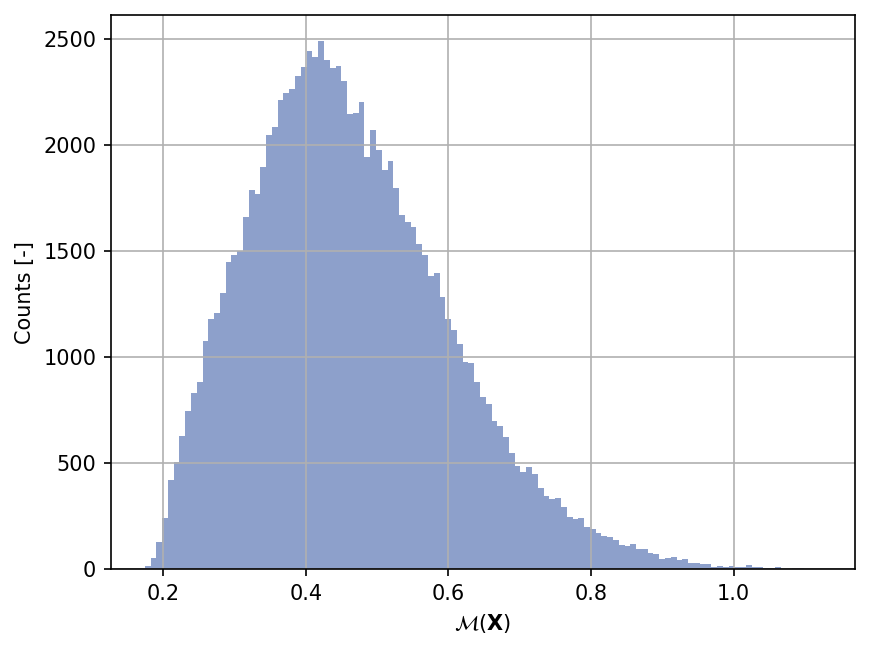
Shown below is the histogram of the output based on \(100'000\) random points:
Show code cell source
np.random.seed(42)
xx_test = my_testfun.prob_input.get_sample(100000)
yy_test = my_testfun(xx_test)

plt.hist(yy_test, bins="auto", color="#8da0cb");
plt.grid();
plt.ylabel("Counts [-]");
plt.xlabel("$\mathcal{M}(\mathbf{X})$");
plt.gcf().set_dpi(150);
Moments estimation#
Shown below is the convergence of a direct Monte-Carlo estimation of the output mean and variance with increasing sample sizes.
Show code cell source
# --- Compute the mean and variance estimate
np.random.seed(42)
sample_sizes = np.array([1e1, 1e2, 1e3, 1e4, 1e5, 1e6, 1e7], dtype=int)
mean_estimates = np.empty(len(sample_sizes))
var_estimates = np.empty(len(sample_sizes))

for i, sample_size in enumerate(sample_sizes):
    xx_test = my_testfun.prob_input.get_sample(sample_size)
    yy_test = my_testfun(xx_test)
    mean_estimates[i] = np.mean(yy_test)
    var_estimates[i] = np.var(yy_test)

# --- Compute the error associated with the estimates
mean_estimates_errors = np.sqrt(var_estimates) / np.sqrt(np.array(sample_sizes))
var_estimates_errors = var_estimates * np.sqrt(2 / (np.array(sample_sizes) - 1))

# --- Do the plot
fig, ax_1 = plt.subplots(figsize=(6,4))

ax_1.errorbar(
    sample_sizes,
    mean_estimates,
    yerr=mean_estimates_errors,
    marker="o",
    color="#66c2a5",
    label="Mean",
)
ax_1.set_xlabel("Sample size")
ax_1.set_ylabel("Output mean estimate")
ax_1.set_xscale("log");
ax_2 = ax_1.twinx()
ax_2.errorbar(
    sample_sizes + 1,
    var_estimates,
    yerr=var_estimates_errors,
    marker="o",
    color="#fc8d62",
    label="Variance",
)
ax_2.set_ylabel("Output variance estimate")

# Add the two plots together to have a common legend
ln_1, labels_1 = ax_1.get_legend_handles_labels()
ln_2, labels_2 = ax_2.get_legend_handles_labels()
ax_2.legend(ln_1 + ln_2, labels_1 + labels_2, loc=0)

plt.grid()
fig.set_dpi(150)
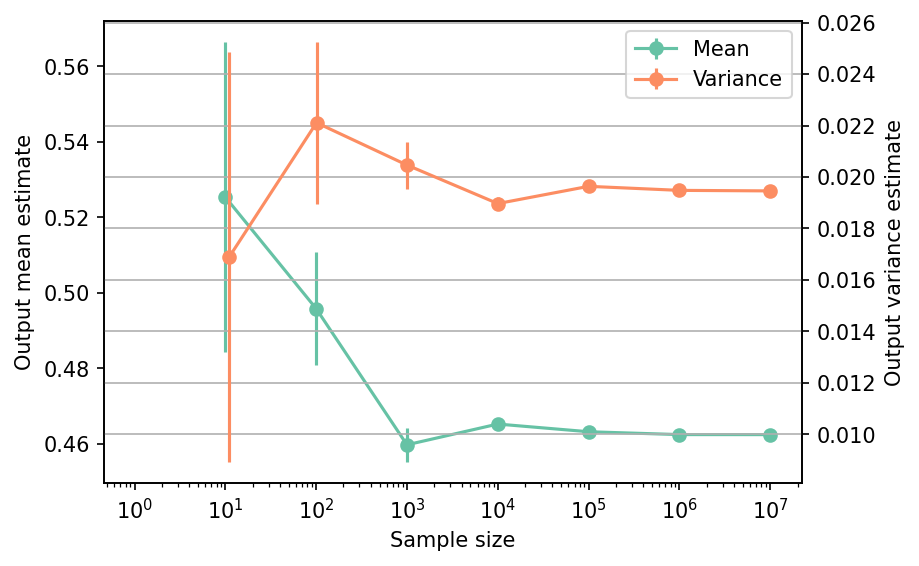
The tabulated results for each sample size is shown below.
Show code cell source
from tabulate import tabulate

# --- Compile data row-wise
outputs = []
for (
    sample_size,
    mean_estimate,
    mean_estimate_error,
    var_estimate,
    var_estimate_error,
) in zip(
    sample_sizes,
    mean_estimates,
    mean_estimates_errors,
    var_estimates,
    var_estimates_errors,
):
    outputs += [
        [
            sample_size,
            mean_estimate,
            mean_estimate_error,
            var_estimate,
            var_estimate_error,
            "Monte-Carlo",
        ],
    ]

header_names = [
    "Sample size",
    "Mean",
    "Mean error",
    "Variance",
    "Variance error",
    "Remark",
]

tabulate(
    outputs,
    headers=header_names,
    floatfmt=(".1e", ".4e", ".4e", ".4e", ".4e", "s"),
    tablefmt="html",
    stralign="center",
    numalign="center",
)
| Sample size | Mean | Mean error | Variance | Variance error | Remark |
|---|---|---|---|---|---|
| 1.0e+01 | 5.2537e-01 | 4.1089e-02 | 1.6883e-02 | 7.9588e-03 | Monte-Carlo |
| 1.0e+02 | 4.9583e-01 | 1.4869e-02 | 2.2110e-02 | 3.1426e-03 | Monte-Carlo |
| 1.0e+03 | 4.5979e-01 | 4.5237e-03 | 2.0464e-02 | 9.1563e-04 | Monte-Carlo |
| 1.0e+04 | 4.6528e-01 | 1.3772e-03 | 1.8966e-02 | 2.6824e-04 | Monte-Carlo |
| 1.0e+05 | 4.6324e-01 | 4.4313e-04 | 1.9637e-02 | 8.7819e-05 | Monte-Carlo |
| 1.0e+06 | 4.6249e-01 | 1.3957e-04 | 1.9480e-02 | 2.7549e-05 | Monte-Carlo |
| 1.0e+07 | 4.6248e-01 | 4.4112e-05 | 1.9459e-02 | 8.7024e-06 | Monte-Carlo |
References#
Hyejung Moon. Design and analysis of computer experiments for screening input variables. PhD thesis, Ohio State University, Ohio, 2010. URL: http://rave.ohiolink.edu/etdc/view?acc_num=osu1275422248.
Einat Neumann Ben-Ari and David M. Steinberg. Modeling data from computer experiments: an empirical comparison of kriging with MARS and projection pursuit regression. Quality Engineering, 19(4):327–338, 2007. doi:10.1080/08982110701580930.